Flying cars are real, apparently
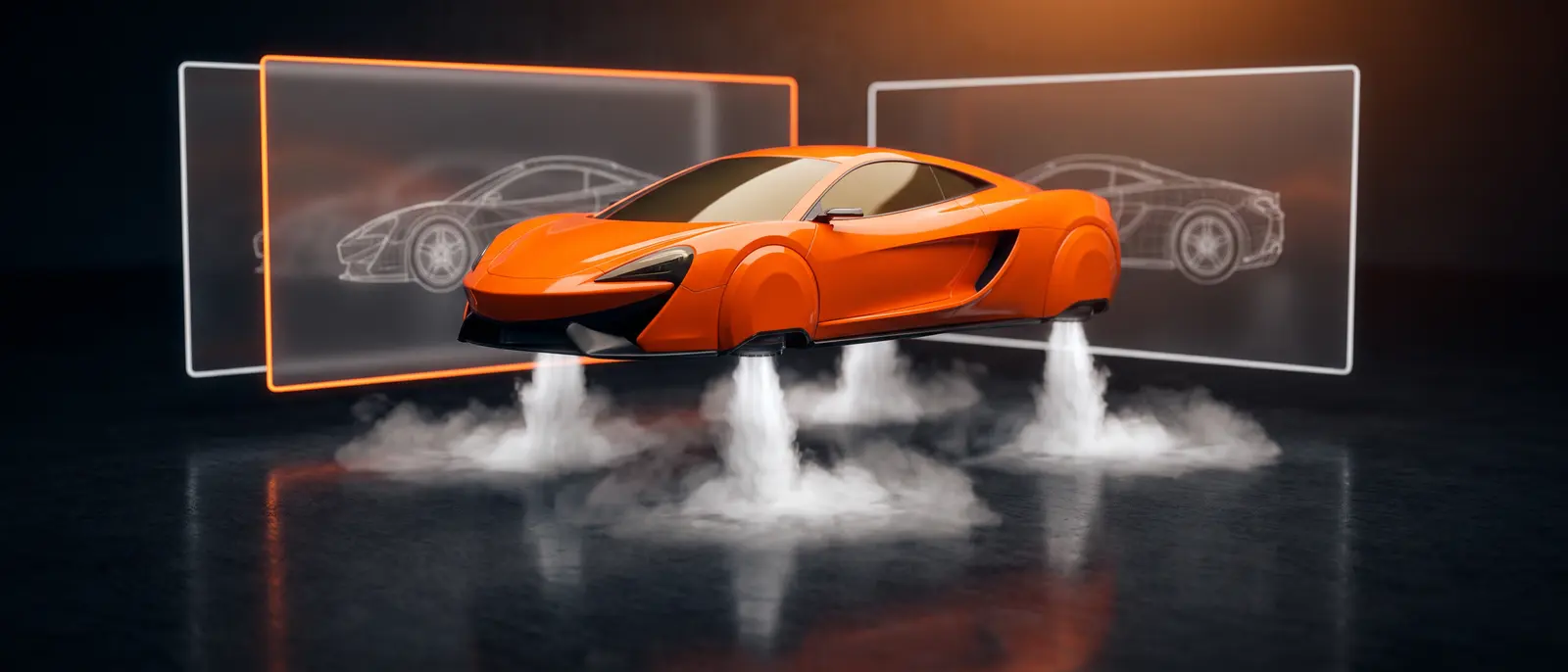
On Thursday 15 October 2026, Tesla finally showed the new Roadster at SpaceX's test site in McGregor, Texas, livestreamed on X. A car with no one in it drove up a ramp that curled over until it was fully upside down, clung to the surface, launched off the end, rolled 180 degrees in mid-air and landed on its wheels.
The tech, according to Tesla, is a fan system sucking the car onto the road with more than 2G of downforce, plus cold-gas thrusters borrowed from SpaceX. It claims 0 to 60mph in 0.81 seconds and production in 2028. The flying version isn't approved for public roads - yet?! The $5,000 reservation is for one that doesn't fly.
It's a brilliant piece of theatre. It's also a neat case study in a question every brand is about to face: when anything can be faked, what actually counts as proof?
A live audience proves the event, not the product
I've thought for a while that experiential marketing is about to have a second life. When any video can be generated, "I was there" becomes one of the few things left that carries weight. Musk clearly thinks the same: he made a point of having people on site to show it was real.
There's a name for why this matters now. Legal scholars Bobby Chesney and Danielle Citron call it the liar's dividend: once fakes are everywhere, real footage can be dismissed as fake too. That cuts both ways for Tesla. Even if every second of this demo was genuine, a lot of people will assume it wasn't. Video on its own has stopped settling arguments.
But look at what those people could actually see. The car was remote controlled with nobody inside. Spectators were kept several hundred yards back because the thrusters are loud enough to damage your hearing. From that distance you can confirm that a car went up a ramp, came off upside down and landed. You can't confirm how.
Was it fan suction holding it to the track, or something in the track holding the car? Earlier reports said Tesla's original plan involved a magnetised, roller-coaster-style ramp, later scaled back. I'm not saying it was rigged. I'm saying a witness at that range couldn't tell you either way, and nor can the livestream.
And the look of the footage settles nothing either way. Volvo's 2013 Epic Split ad, with Jean-Claude Van Damme balanced between two reversing lorries, was real, and plenty of people still assumed it was CGI. Tesla's own Cybertruck reveal in 2019 went the other way: the "unbreakable" windows shattered on stage, and plenty of people decided that was staged for the headlines. Polish invites suspicion, but so does a convenient failure. A mistake is just as easy to script as a success, and a generated one even more so. Neither tells you anything. Only checking does.
That's the distinction worth holding onto. Being there proves something happened. It doesn't prove the product does what's claimed. In a world of deepfakes, the brands that win trust won't just stage spectacles. They'll let people get close enough to check.
Another delay, wrapped in a backflip
Let's not lose the headline underneath the headline: the Roadster has slipped again. It was first shown in 2017 with production pencilled in for 2020. Founders Series buyers put down $250,000 that year. Last year Musk picked April Fools' Day 2026 for the reveal, partly, he said, for the deniability. That came and went. Now it's 2028.
Announce "another two years" on its own and the story writes itself. Announce it alongside a car driving upside down and nobody's writing about the date. Musk even hedged on stage, saying success wasn't guaranteed but it would probably work. That's not the language of a product launch. It's the language of a demo buying time.
I don't think that's cynical. It's smart. But it's worth naming, because the trick only works if you're watching the car and not the calendar.
SpaceX lends Tesla its swagger
Whatever you think of the physics, the brand play is clever. Every detail borrowed from SpaceX: the rocket test site as the venue, thrusters straight from spacecraft, white paint and gold-tinted glass meant to echo Apollo spacesuits. Tesla gets to stand in SpaceX's reflected glory without saying so out loud (even though they did several times).
It isn't the first time either. In February 2018, the first Falcon Heavy launch carried Musk's own original Roadster into space, with a mannequin in a spacesuit called Starman at the wheel and Bowie's Space Oddity on the stereo. A test payload became one of the most shared images of the decade. Eight years on, the roles have reversed: the Roadster went to space, and now space has come to the Roadster.
That's cross-pollination done properly. Most brand collaborations are a logo swap. This one moved actual engineering, and with it a story, from one company to another. Lining up the Tesla fleet for the Roadster to jump over finished the job: the whole range in one shot, cast as the supporting act.
The timing makes sense too. By August, Tesla's share price was down nearly a quarter on the year while attention drifted to robots and robotaxis. A car that flies is a loud reminder that this is still, at its core, a car company?
Who does a stunt like this actually convert?
Here's where I'm less sure it works. If you're already into Tesla, this compounds the loyalty. You've waited nine years and you've just been rewarded with something no other carmaker would attempt - why would they want or need to?
If you're not, I'm not convinced it moves you. Sceptics will see a remote-controlled car, a 2028 date and a deposit for the non-flying version, and file it alongside every other missed deadline. The stunt doesn't answer their objection. It confirms it. Still don't have Full Self Driving everywhere.
The people it might reach are on the fringes: interested in EVs, not sold on the brand or the man behind it, seeing coverage on a more mainstream news outlet. For them, spectacle is a double-edged sword. It gets attention, but the bigger the claim, the higher the bar for belief. The test isn't how many people watched. It's how many of the unconvinced still believe it in 2028.
What the rest of us can take from it
You don't need a rocket test site for any of this to apply. If you're marketing something real in a world of synthetic content, a few things are worth stealing:
- Let people get close. Demos, open days, hands-on trials. Proximity is the proof, not attendance.
- Bring in independent eyes. A journalist or customer who can poke at it is worth more than a polished film.
- Show the unedited version. Raw, uncut footage alongside the edit tells people you've got nothing to hide.
- Don't let the stunt outrun the product. Attention spent on a claim you can't back up is borrowed against future trust.
The brands that come out of the AI era with credibility won't be the ones with the biggest spectacle. They'll be the ones that made checking easy.
The questions nobody asked on stage
Which leaves the practical stuff. How do you actually activate it? A button on the steering wheel? A swipe on the screen with an "Are you sure?" pop-up? Does it ask for confirmation twice when you're doing 60mph?
It's also pitched as the last manual Tesla, though not in the way you'd think. In April, Musk said that long term the Roadster will be the only car in the line-up you drive yourself, with everything else going autonomous. "Manual" here means human-driven, not a gearstick. EVs don't really have gearboxes: a single-speed drive and instant torque make one pointless. Toyota and Ford have both explored fake H-pattern shifters with synthetic engine noise for enthusiasts, which is its own lesson in selling the feeling of a thing rather than the thing. Tesla is doing a version of the same: selling the driver's car from a company that would rather you didn't drive.
And more importantly: how good are the cup holders? Because if this thing is going to be inverted at speed, that's the real engineering challenge...
AI-generated This video is AI-generated. I made it. Nobody was harmed, and no milkshakes were lost.
It took me 50 minutes to make. Which is sort of the whole point. If I can put a microphone in front of a driver mid-spin at a drive-through from my desk, then a slick video proves nothing. Not mine, and not Tesla's. Getting close enough to check is the only proof that's left.
Sources
- Edmunds: first look at the Roadster reveal
- CBS News: Musk shows "flying cars are real"
- Jalopnik: Roadster re-reveal promises flight, production in 2028
- carsales: Tesla Roadster can actually fly says Musk
- Electrek: demo with no one inside, spectators held back (14 August 2026)
- TechCrunch: April Fools' Day reveal date